Clear Path
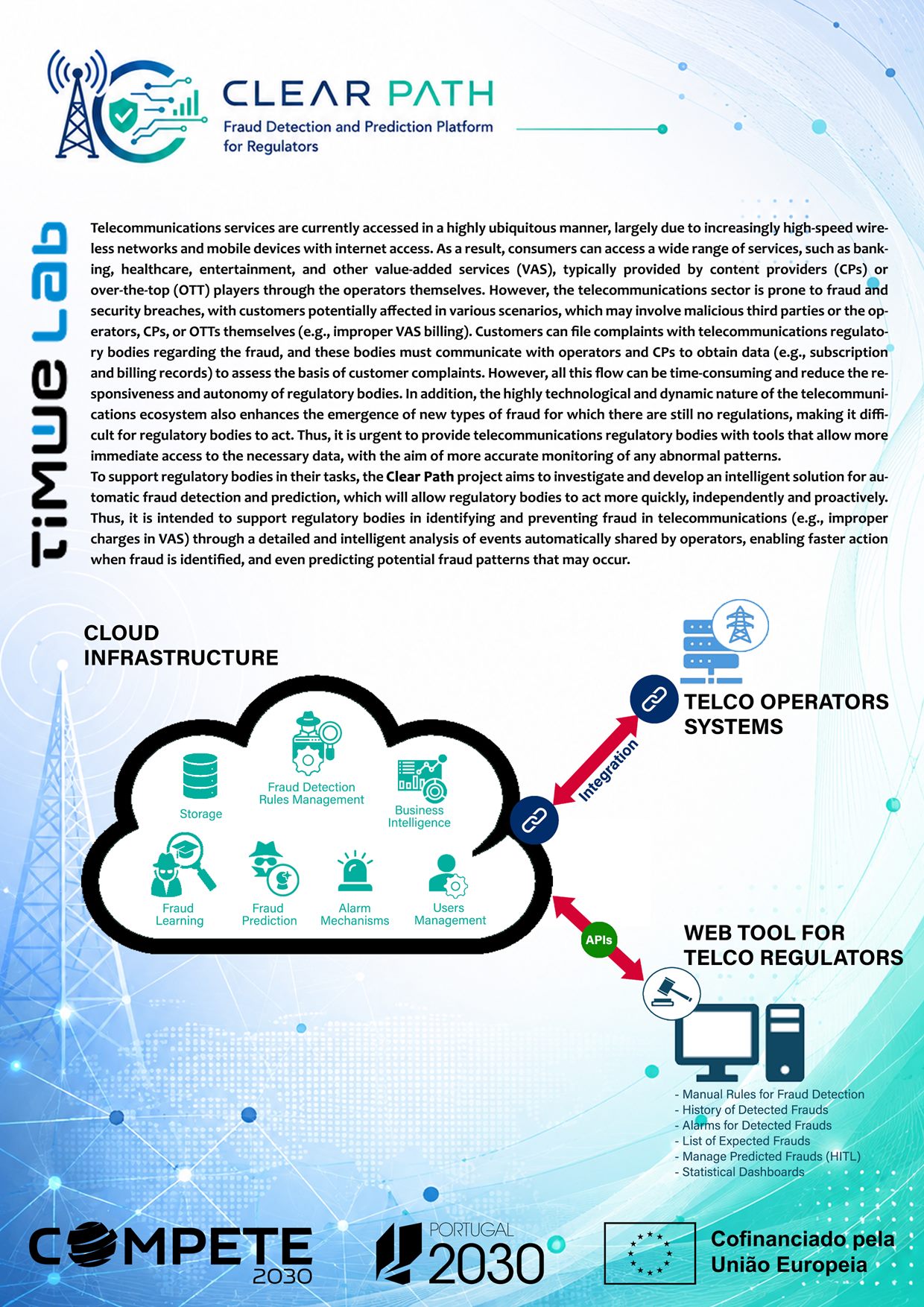
The Clear Path project aims to research and develop an intelligent solution for the automatic detection and prediction of fraud in the telecommunications sector, enabling telecom regulatory authorities to act in a more agile, independent and proactive way.
Decrease the probability of fraud occurring in telecommunications.
Predict the occurrence of the most recent types of fraud.
Make regulatory bodies' response to fraud in the telecommunications sector faster and more agile.
Increase consumer satisfaction with the services provided by operators and content providers.
Project Context
The problem:
Telecommunication services are accessed in an increasingly ubiquitous way, largely due to ever-faster wireless networks and Internet-enabled mobile devices. Consumers can access a wide range of services, such as banking, health, entertainment and news, many of them value-added services (VAS) provided by content providers (CPs) or Over-the-Top players (OTTs) through the mobile operators themselves. However, the telecommunications sector is prone to fraud and security failures, and customers can be affected in several scenarios involving malicious third parties or the operators, CPs and OTTs themselves, such as being charged more than expected for a service, or being charged for a service they never knowingly subscribed to. Cases of this kind have been reported all over the world, including in Portugal, where the national regulator has fined operators for undue VAS activations and charges.
When customers file complaints, regulatory authorities must contact operators and CPs to obtain the data (e.g., subscription and billing records) needed to assess whether those complaints are well-founded. This flow can be slow and reduces the responsiveness and autonomy of regulators. In addition, the highly technological and dynamic nature of the telecommunications ecosystem leads to new types of fraud for which there is still no regulation, leaving regulators in a more reactive than proactive role due to the lack of near real-time monitoring capabilities. It is therefore urgent to provide telecom regulators with tools that give more immediate access to the necessary data and enable a more regular and accurate monitoring of abnormal patterns.
The solution:
The Clear Path project proposes the research and development of an innovative AI-based fraud detection and prediction ecosystem for telecom regulatory authorities, allowing a more agile and proactive action towards fraud identified in the flows of operators and associated CPs. The ecosystem will include a web tool for analysis, reporting and alerting, used by regulators to analyse the data shared by operators, and a supporting cloud infrastructure that will process the main business logic and securely store all information. Clear Path combines manual rule-based detection, Machine Learning mechanisms that learn the patterns of known fraud, and Generative AI mechanisms that predict new, previously unknown types of fraud, keeping regulators in the loop to accept or reject each prediction. In the end, customers are expected to gain greater satisfaction and trust, operators a more positive reputation, and regulators a simpler and more agile regulatory work.
Goals
Fewer fraud occurrences
Reduce the probability of fraud in subscription flows of operators' or associated CPs' services, through the automated learning of typical failure patterns.
Fraud prediction
Predict the occurrence of known and unknown types of fraud in subscription flows of operators' or associated CPs' services.
Faster regulatory response
Improve the responsiveness of regulatory authorities to fraud in the telecommunications ecosystem.
Greater customer trust
Increase customer satisfaction and trust in the services provided through telecom operators.
Better reputation of the ecosystem
Improve the reputation of the services provided by telecom operators and their content provider partners (CPs).
Solution Components
- Storage
- Fraud Detection Rules Management
- Business Intelligence
- Fraud Learning
- Fraud Prediction
- Alarm Mechanisms
- Users Management
Analysis, reporting and alerting web tool
Web-enabled interface used by regulatory authorities to analyse the data shared by operators. Users can consult statistical reports on ingested data, define manual fraud detection rules, view the history of detected fraud, receive alarms about fraud identified by the system, and consult and validate the fraud predicted by the system.
Features
Authentication
Allows registered users to access the tool with their credentials. Different user roles with distinct permissions may exist, e.g., a role with access to all features and to the data of all operators in the country, and another role restricted to some features or to a single operator.
Manual fraud detection rules
Allows users to define manual rules to detect potential fraud in the flows of operators and CPs, such as thresholds for the maximum number of subscriptions of a given VAS in a period of time, the average number of billing attempts per hour, or the number of cancellations of a service per day.
Charts, dashboards and statistics tables
Allows users to view charts, dashboards and tables with statistics on the operators' data ingested by the system, such as subscriptions per day, cancellations per day, blacklisted customers per service/CP or total charges per day.
Detected fraud history
List of the fraud detected by the system, including the affected customers, the reason, the time of occurrence, the service, the CP and the associated operator. History events can be exported as a report.
Fraud Learning
Machine learning mechanisms that learn from historical data and detected fraud cases to identify abnormal patterns.
Detected fraud alarms
Real-time (or near real-time) notifications about detected fraud, based on the indicators defined for each type of fraud, giving users a more immediate perception of fraud occurring in operator/CP flows.
Predicted fraud list
List of fraud suggestions predicted by the solution itself, based on the analysis of anomalous event patterns that were not previously identified or defined by the user.
Accept/reject predicted fraud (Human-in-the-Loop)
Users can accept each predicted fraud, turning it into a general fraud identification rule, or reject it, discarding the analysis of that potentially anomalous pattern.
Deliverables