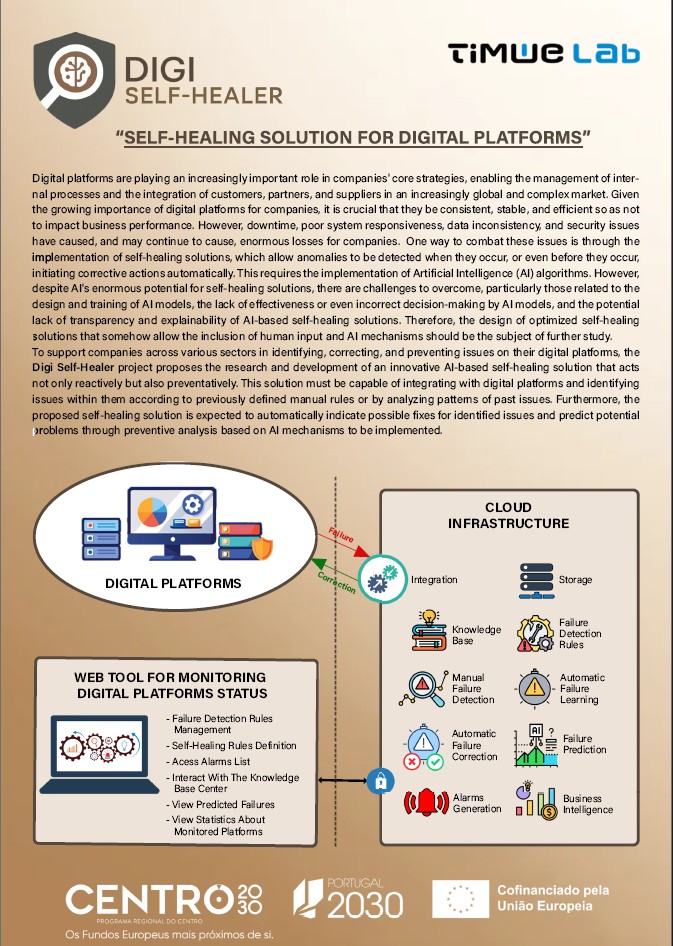


Web tool for monitoring the status of digital platforms
Web-enabled interface for entities to use to assess the status of their digital platforms in real time.
Manual rules configuration for failure detection
Users can define manual rules for detecting failures in their organizations' digital platforms, such as thresholds for the minimum and maximum number of calls made to a given service, the maximum expected response time for a request made to a given API, firewall configurations, exclusion rules, etc.
Application of manual or automatic self-healing rules
This feature allows users to choose whether to apply manual rules, previously defined by themselves, or automatic rules, internally learned by the self-healing solution itself, to identify failures in each of the characteristics of the digital platforms under analysis.
Alarms and notifications
The monitoring tool will provide alarms and notifications to its users regarding three aspects: failures detected on digital platforms that require user action; failures detected on digital platforms that were automatically resolved by the self-healing solution; and detection of potential failures that will occur on digital platforms (preventive action).
Interaction with the system's intelligence center
Users of the monitoring tool will also be able to question the self-healing solution's intelligence center (Generative AI mechanisms) about the operating status of the integrated digital platforms or about resolutions for potential problems, such as whether the number of requests arriving for a given service is within the expected range, what configurations are necessary for a given service to be more responsive, etc.
Correction History
A correction history table available in the digital platform status monitoring tool provides a record of corrections applied to the platforms under analysis. This history table provides information about the type of correction applied, the parameter to which the correction was applied, when it was applied, and more.
List of suggested corrections to be applied
This feature provides a list of next best actions for some errors detected on digital platforms. The suggestions presented will relate to corrections that the self-healing solution interprets as the most appropriate to implement for each of the identified errors.
Graphs and Dashboards
The web tool provides graphs and dashboards with information about the evolution of the parameters to be monitored on the digital platforms integrated with the self-healing solution. This information may include the number of requests per minute for a given service that reached the platform, the amount of information processed per minute, the number of accesses per hour, and other statistics to be investigated. The number of faults detected per day, number of corrections applied per day, etc., will also be taken into account.